Marmeladov family’s destitution
Crime and PunishmentMarmeladov family’s destitution is a household crisis sustained by inadequate income, illness, hunger, and Semyon Zaharovitch Marmeladov’s repeated drinking. Its effects are distributed unequally: Katerina Ivanovna carries the burden of domestic work and illness, while Sofya Semyonovna Marmeladova is driven to earn money in a way that separates her from the family. A short period of employment briefly changes the household’s daily life, revealing how sharply even a small, regular income can alter its prospects.
Housing and Material Hardship
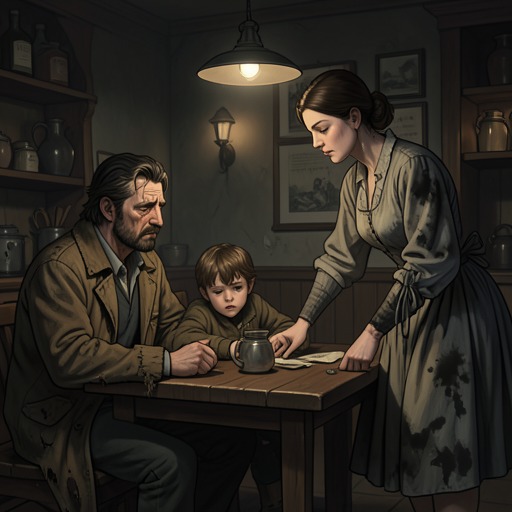
The family lives in only part of a room in the lodging house of Amalia Fyodorovna Lippevechsel, shared with numerous other people. Semyon describes the rooms as dirty and disorderly, and cannot say how the household meets its rent or pays for its daily living. Their housing is therefore not simply cramped: even its basic costs remain uncertain. The family has little private space or security in which to recover from one crisis before another arrives.
The material shortages are concrete. Semyon has sold Katerina’s stockings and a mohair shawl that had been given to her, using the proceeds for drink. The family lives in a cold room; Katerina catches cold, begins coughing blood, and has a weak chest and a tendency to consumption. Three young children depend on the household, and at one point there is no bread for them for three days. In these circumstances, clothing, warmth, food, and health are not separate concerns: the loss of a garment to drinking leaves the household more exposed, while illness further limits the work on which it depends.
Work, Hunger, and the Burden of Care
Katerina works from morning until night, scrubbing, cleaning, and washing the children. She was accustomed to cleanliness from childhood, but the cramped, chaotic lodging and lack of resources make maintaining it a continuing effort rather than a secure condition. Her physical weakness compounds the labor she performs: Semyon knows that her chest is fragile, yet she continues to shoulder the household’s daily work while the children are hungry.
The prospects for earning money through respectable work are bleak. Semyon estimates that a poor girl without a special skill might earn less than fifteen farthings a day, even while working continuously. He describes how Sofya Semyonovna Marmeladova has also made linen shirts for Ivan Ivanitch Klopstock, a civil counsellor, who has not paid her for half a dozen shirts and instead dismissed her over their collars. The episode makes the family’s poverty more than a matter of low wages: work can consume time and effort without producing the money needed for food.
Sofya, Semyon’s daughter by his first wife, grew up amid hardship and received little formal education. Semyon says that an attempt to teach her geography and universal history ended because he lacked sufficient knowledge and the family lacked suitable books; the lessons stopped at Cyrus of Persia. This detail places deprivation beyond the immediate shortage of meals: it also limits the resources, time, and instruction available to the children as they grow.
Sofya’s Contribution and Separation
When the children are hungry and the household is desperate, Sofya asks Katerina whether she must take a course of action she is reluctant to accept. Semyon, lying drunk, witnesses the consequences. Sofya leaves at six in the evening and returns around nine with thirty roubles, which she places silently on the table. She covers her head and face with the family’s large green shawl and lies facing the wall, her shoulders and body shuddering. The account gives the amount and the household’s response without turning her distress into a solution: the money helps those at home, but her return is marked by silence and pain.
Katerina’s response complicates the earlier conflict between the women. She goes to Sofya’s bed, kneels, and kisses her feet; the two fall asleep in each other’s arms. The family’s hardship has strained their relationship, but the scene shows Katerina’s attachment and remorse alongside Sofya’s sacrifice. Semyon remains drunk as this exchange takes place, a contrast that leaves the practical and emotional consequences of poverty borne chiefly by the women.
Later, after an incident involving hostile reports and opposition from people in the lodging house, Sofya is compelled to take a yellow ticket and cannot continue living with the family. The account connects that enforced separation with the household’s vulnerability and with disputes involving the landlady and Mr. Lebeziatnikov. Sofya now visits mostly after dark, comforts Katerina, and gives the family what she can. Her contribution continues, but it does not restore her place in the shared rooms; financial support and family belonging have been pulled apart by the conditions of survival.
Employment and a Brief Reversal
Semyon’s account also records a temporary change. After periods of work and lost employment, he obtains a post again. For five weeks, Katerina and Sofya respond as though the household has entered a different world: they quiet the children so he can rest, make coffee, and obtain cream for him. They find eleven roubles and fifty copecks for a proper outfit, including boots and shirt-fronts, and Katerina prepares soup and salt meat with horseradish for dinner. With no new dresses, she arranges her hair and puts on a clean collar and cuffs, appearing changed to Semyon.
This improvement remains limited and depends on his employment, but it alters both the household’s comforts and its public dignity. Katerina invites Amalia Fyodorovna Lippevechsel to coffee despite their recent quarrel, and speaks proudly of Semyon’s return to office work. Sofya, who has helped with money, says she will visit only occasionally and after dark, so the new salary does not erase the separation imposed on her. The episode makes the family’s instability especially visible: a few weeks of wages can provide meals, clothing, and renewed recognition, while its benefits remain fragile and unevenly shared.
Narrative Significance
The family’s poverty is revealed through specific transactions and routines: shirts made but not paid for, clothing sold for drink, children without bread, work carried out through illness, and thirty roubles placed on a table. These details show how deprivation moves through the household, converting unpaid labor and bodily effort into temporary relief while leaving the underlying insecurity intact. The brief return of wages supplies a contrast rather than a lasting resolution; coffee, a proper outfit, and a cooked dinner demonstrate what income can change, while Sofya’s continuing visits after dark show what it cannot undo.
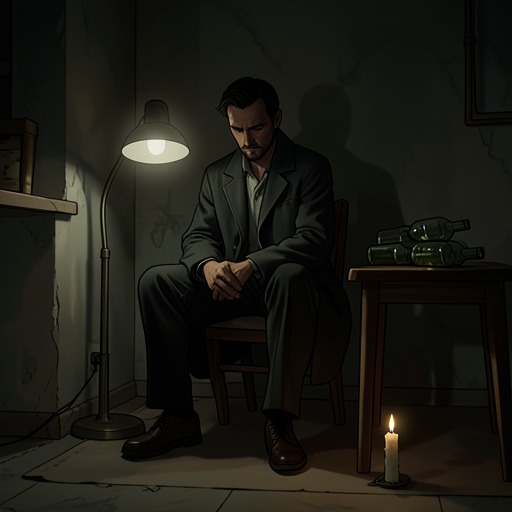
When Semyon tells this history to Rodion Romanovitch Raskolnikov, he presents the family’s condition as an accumulation of losses and compromised choices rather than as a single misfortune. His account also implicates his own drinking: he acknowledges that he sold Katerina’s possessions for alcohol and lay drunk as the household struggled. The family’s destitution thus binds material scarcity to damaged trust and unequal responsibility, while the episodes of mutual care—Katerina kissing Sofya’s feet and Sofya continuing to bring help—register the attachments that persist within that precarious life.